10 European Cities You Never Thought You'd Visit
Walking down Las Ramblas in Barcelona, sitting in a café in Saint-Germain-des-Prés in Paris or admiring the canals in Amsterdam always has its charm.
But Europe has plenty of other wonderful, less-touristy places. So we have selected ten underrated cities in Europe that you would never have thought to visit.
Sarajevo, Bosnia and Herzegovina 
Sarajevo is a fascinating city, full of contrasts and history, representing the spirit of the Balkans: minarets and mosques, Christian and Orthodox churches, mixed cemeteries, neighbourhoods of Bosnian Serbs, defence lines, a historical centre with Muslims, Serbs, Bosnians, Croats and other ethnic minorities.
Always a meeting point between East and West, Sarajevo is a city where Ottoman and Habsburg architecture coexist.
A city that has known destruction but also rebirth. The symbol of this is Vijećnica, the National Library, which went up in flames in 1993 after a targeted bombing, but which came back to life in 2014 after more than two decades of restoration.
Between minarets, domes, spires, Art Nouveau buildings and palaces of socialist rationalism, you will discover a city where you can walk through ancient and recent history.
Belgrade, Serbia
Belgrade stands out from other European capitals.
It is the only city in Europe to rise at the point where two great rivers meet, the Sava and the Danube.
After difficult years leading up to the dissolution of the Socialist Federal Republic of Yugoslavia, Belgrade is now considered the Berlin of the Balkans.
For the past decade, the city has boasted a vibrant cultural, artistic and even nightlife that attracts more and more tourists. A good starting point to discover the city is the Kalemegdan Fortress, which defends Belgrade from the top of a hill.
It is also interesting to visit the Museum of Yugoslavia, in the garden pavilions of what was Tito's residence from 1945 to 1979, and the Nikola Tesla Museum, opened in what was the home of the inventor, physicist and electrical engineer in Belgrade until he moved to the United States. With its romantic yet effervescent atmosphere, Belgrade is a city to discover as soon as possible.
Vilnius, Lithuania 
Cosmopolitan, lively and rich in history, Vilnius is a city still underestimated by mass tourism and this is its beauty.
It is a city that has grown and changed rapidly in recent times, especially since Lithuania became an independent country again in 1991.
Founded in the 14th century at the confluence of the River Neris and the River Vilnia, to which it owes its name, the Lithuanian capital enshrines its history in the wonderful Old Town, one of the largest and best-preserved in Eastern Europe, declared a UNESCO World Heritage Site.
Strolling through the Old Town's winding streets, red-roofed houses and Orthodox church spires, you will see numerous Catholic churches.
These include the Cathedral of St Stanislaus and St Vladislaus, the most important place of worship for Lithuanian Catholics, which houses in its crypt the sarcophagi of the Grand Duke of Lithuania and King of Poland Alexander, the only ruler of Poland and Lithuania buried in Vilnius.
Inside the church, admire the 17th-century Chapel of St. Casimir and outside pay attention to the so-called Stebuklas (miracle), a stone which, according to legend, grants wishes by turning it around three times.
Also in the centre of Vilnius is the University, founded in 1579, one of the oldest in the world. The Presidential Palace of Vilnius will dazzle you with its whiteness: it is an elegant neoclassical palace dating back to the early 19th century where the Lithuanian president resides.
Then don't miss the Jewish quarter where, until the beginning of World War II, 40,000 Jews lived who made Vilnius an important Jewish centre in the world, so much so that the city became known as Little Jerusalem.
Here you will see the monument dedicated to Tsemakh Shabad, the legendary ghetto doctor, and the Moorish-style Choral Synagogue. But also take a tour of the district of Užupis, which since 1998 has been an independent republic with its own constitution, its own currency and its own president.
Then street art, murals, installations and numerous festivals make Vilnius a culturally vibrant city.
Tallinn, Estonia 
The capital of Estonia is one of the most underrated European capitals, as well as the European Green Capital 2023.
Tallinn is considered the pearl of the Baltic Sea, declared a UNESCO World Heritage Site as it is one of the European cities that has best preserved traces of its medieval past.
The former Soviet city boasts ancient streets and Gothic spires that coexist with glass skyscrapers, Baroque palaces and modern restaurants.
Tallinn bears the legacy of its Soviet past, but it is also a city with a lively and original future-oriented atmosphere. So take a stroll through the Old Town, also known as the Upper Town, past Vene Street, the city's most distinctive street for having been the street of Russian merchants.
Visit the Gothic Church of St Olaf with its 124-metre high bell tower and don't miss Kadriorg Palace, a magnificent Baroque palace, once the residence of the Tsar and now home to the Estonian National Art Museum.
Finally, Tallinn is known as the city of Christmas for its traditional festivities, the thousands of lights in the Old Town and the markets that draw thousands of visitors to Town Hall Square every year. From Toompea Castle, then, the city looks beautiful, even more so when whitewashed by snow.
Basel, Switzerland 
Basel is Switzerland's oldest university city. Built on the banks of the Rhine in the north-western part of Switzerland between the Jura mountains, the Black Forest and the Alsatian Vosges, the city, the third largest in the country after Zurich and Geneva, lies at the crossroads with France and Germany, close to the capital Bern.
Basel is also the city with the highest density of museums in Switzerland, numbering some 40. World-famous museums such as the Kunstmuseum (ancient and modern art), the Museum of the Sculptor Jean Tinguely, the Beyeler Foundation and the Museum of Cultures are accompanied by numerous galleries and foundations. The heart of the city is its wonderful old town, well-preserved and full of 15th-century buildings, crossed by the Rhine River.
In the old town, you will be fascinated by the Town Hall, the Rathaus, a red building standing out against the beautiful Market Square, the Marktplatz, the late Romanesque and Gothic-style Basel Cathedral and the old Spalentor, one of the three gates that survived the demolition of the city walls in the mid-19th century. Also of interest are Tinguely's bizarre fountain, the Mittlere Bruck, a bridge built in 1905 on the original 1225 model, and the Barfüsser church converted into the City History Museum. In stark contrast to the old town are glittering buildings of modern architecture designed by world-famous architects such as Richard Meyer, Renzo Piano, Zaha Hadid, Tadao Ando and Mario Botta. Finally, Basel is a green city. The Botanical Garden, numerous parks and the banks of the Rhine invite for relaxing walks. The Black Forest is also close by.
Antwerp, Belgium 
Antwerp is the most underrated city in Belgium. It is the second largest city in Belgium and is located in East Flanders just 45 kilometres north of Brussels.
Antwerpen in Flemish and Anvers in French is the country's main port and fascinates with its juxtaposition of old and new: eclectic Art Nouveau residences stand side by side with neo-Renaissance villas, medieval castles and trendy clubs.
In the cobbled alleys of the old town with its medieval charm, you will see the Cathedral of Our Lady of Antwerp, considered the most beautiful Gothic cathedral in Belgium, built over 169 years, from 1352 to 1521. Admire the many picturesque period palaces and old houses of wealthy merchants.
Don't miss the Rubenshuis Palace, the residence and studio of Rubens, the master of the Baroque, who lived here for about thirty years in the early 17th century. Designed by Rubens himself, the house-museum with its Baroque arcade, Renaissance garden and Italian-style building displays 10 of the painter's canvases. You will see
also that the city develops around Grote Mark, the market square, overlooked by the town hall, the Stadhuis. The Meir street is the shopping street lined with 18th- and 19th-century buildings where you can find small boutiques, tea rooms, grocery shops, high-fashion shops, antiques, watch shops and chocolate shops. Also worth a visit is Antwerp's oldest building, Het Steen Castle, a medieval fortress in the heart of the city that stands on a hillock by the Scheldt River on the site of the ancient Gallo-Roman settlement of Antwerp. Built between 1200 and 1225, the castle houses the former courthouse, the Church of St. Walburga, the pier and the fish market. Not far away is the diamond quarter and the Diamantmuseum. Then explore the so-called fashion district and the Zurenborg quarter, which houses true masterpieces of Art Nouveau architecture. Finally, Antwerp will surprise you with its lively nightlife and multicultural atmosphere.
Rotterdam, Netherlands 
Rotterdam, located in the west of the Netherlands, is the country's second most populated city and an important commercial centre, home to one of the world's busiest ports.
Almost completely destroyed by World War II bombings, today Rotterdam has been reborn as an innovative, vibrant and sophisticated city. Redesigned by archistars, Rotterdam is known as the city of architecture with an ever-changing skyline.
The infamous harbour areas have become hipster and trendy zones; the Erasmusburg, the landmark bridge dedicated to its most illustrious citizen, Erasmus of Rotterdam, has been built; a series of iconic buildings of eccentric design have sprung up, such as Norman Foster's World Port Center, Álvaro Siza's New Orleans, Francine Houben's Montevideo, Renzo Piano's KPN Tower, the new Central Station or the Markthal.
The latter is the first covered food market in the Netherlands, opened in 2014, which looks like a modern horseshoe-shaped structure. Then take a look at the Cube Houses, amazing cubic houses designed by architect Piet Blom.
This innovative metropolis on water then surprises with its wide range of museums, including the latest, opened in 2021, the Depot Boijmans Van Beuningen.
It is not a museum proper, but the first repository of works of art, in the shape of a large bowl, 39.5 metres high and with a surface area of 15,541 square metres, entirely covered with mirrored panels and powered by solar energy. The city also retains some evidence of its past, such as the late Gothic church dedicated to St. Lawrence, the city's patron saint, on Grotekerk square.
It is worthwhile for once to choose Rotterdam instead of the better known Amsterdam or Utrecht.
Pula, Croatia 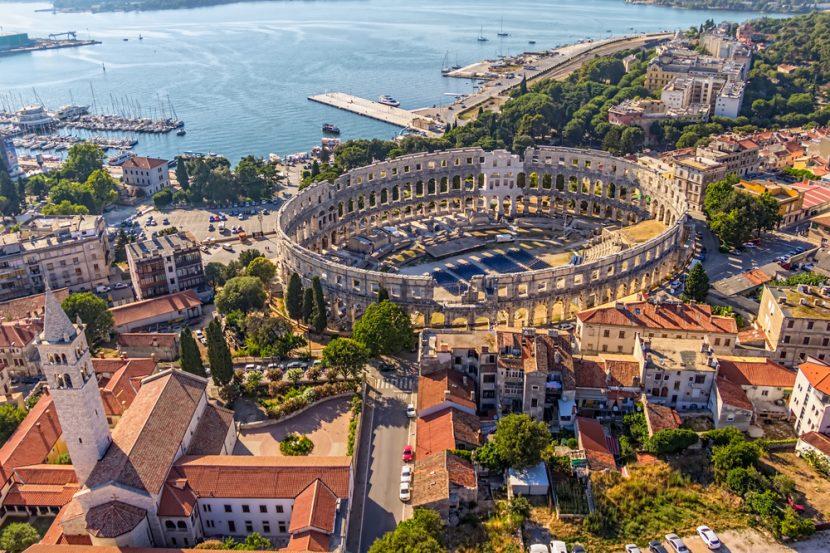
The capital of the Istrian peninsula, Pula is one of Croatia's largest cities and an attractive coastal town remembered for its iconic Roman amphitheatre overlooking the sea.
Pula's landmark arena is the sixth largest in the world and is beautifully preserved, hosting concerts and other cultural events in summer.
But it is not the only evidence of Roman times. Strolling through the old town you can admire the remains of the Roman walls, a temple dedicated to Augustus, the Porta Erculea, the Triumphal Arch of the Sergi and a mosaic floor dating back to the 3rd BC with geometric motifs and a representation of Circe's punishment.
If you want to learn more about history, you can visit the Istrian Archaeological Museum, which houses exhibits from prehistory to the Middle Ages from all over Istria. Among the most interesting religious buildings in the town, it is worth visiting the cathedral, rebuilt in the 14th century on the remains of an earlier Roman construction, and the chapel of St. Mary Formosa, which is what remains of an ancient Benedictine abbey.
After visiting the city, relax on the beautiful beaches in the surroundings. By bus, for example, you can reach the beaches of the Verudela Peninsula, which despite being overrun by tourism remains a beautiful stretch of coastline with pine forests, seaside cafes and excellent restaurants. Pula is also a good base from which to explore other famous locations in Istria such as Porec or Rovinj. The Kamenjak Park, the village of Medulin and the Brijuni Islands can be reached in a day trip.
Bamberg, Germany 
Bamberg dates back to the Roman Empire and, like the Eternal City, stands on seven hills. It has a Unesco World Heritage-listed medieval centre dominated by the imposing cathedral with its four steeples and the Altes Rathaus, the old town hall.
Next to the cathedral is the Neue Residenz, built by the city's prince-bishop from 1613. Don't miss the Kaisersaal, adorned with illusionistic frescoes and portraits of Holy Roman Emperors, and the magnificent Rose Garden, with 4,500 roses from 48 different species.
Lovers of Baroque architecture should visit the Grüner Markt area, which is also famous for its fruit and vegetable market at Maxplatz, where St. Martin's Church is located. Then visit the Böttingerhaus, considered to be one of the highest examples of German Baroque patrician houses.
On Schillerplatz is the house where the romantic writer and poet E. T. A. Hoffmann lived from 1808 to 1813. Don't miss a tour of 'Little Venice', where old fishermen's houses with colourful facades are lined up along the Regnitz River.
Finally, head to the Michaelsberg hill to visit St. Michael's Church and the Benedictine monastery annex, founded in early 1015, which is now a retirement home for the elderly. From the terrace you can admire one of the best views of Bamberg and the surrounding countryside. For a break, be sure to try the smoked beer, the famous Rauchbier, at the Schlenkerla brewery.
Tirana, Albania 
Tirana is the vibrant and colourful capital of Albania, now unrecognisable from the grey days of communism.
A city steeped in history, Tirana combines the Ottoman architecture of the Et'hem Bey mosque with the neo-Baroque and rationalist buildings of the ministries' palaces, dating back to the Italian occupation of Albania, and the square, essential buildings typical of communist architecture such as the National History Museum.
All this in Scanderbeg Square, the emblem of the entire city. Start your tour at the 35-metre high Clock Tower, an icon of Tirana since 1820, and then immerse yourself in this chaotic, bustling, dusty city.
Don't miss Bunk'art 2, the bomb bunker that now houses a museum dedicated to the communist dictatorship, the Tanners' Bridge over the Lana River, which dates back to the 8th century, Ottoman period, and the Postbllok Memorial i izolimit komunist, a memorial to the communist past.
Also visit the Hoxha Pyramid, the mausoleum of dictator Enver Hoxha, now a youth cultural centre. Pass by the Central Market or take a break between bars and cafés in the dynamic and trendy Blloku district.
Destinations
Low Cost News